

From Waste to Worth:
Lessons from Deconstructing an Auckland House
Levin Daniel JV - recent Masters graduate of Auckland University of Technology (AUT).
Material recovery and embodied carbon in practice for New Zealand builders
In my Master of Construction Management capstone at AUT, I chose deconstruction to test what circular economy looks like on a real site. We deconstructed a 1990s timber-framed house in suburban Auckland and tracked where materials went to see what could realistically be recovered on a typical residential job. The work was later presented as an award-winning paper at the GDI 2025 conference.
Deconstruction is skilled work, not “just pulling things apart”
Deconstruction is skilled work. Dismantling linings, fixtures and structure takes time, care and planning. In some places, a single timber joint held eight nail-gun fixings at different angles, many rusted and brittle. It showed how quickly recovery can pressure the build schedule without consistent fixings and deconstruction-ready detailing.
From waste pile to material stock
"One person’s trash is another person’s treasure”. On our site, this was literal!
With an early walk-through, we identified what was worth saving and planned to work from the inside out:
Bricks: set aside for reuse on site.
Timber: sound pieces stacked for potential reuse; short, worn untreated offcuts dried and used as firewood next door.
Treated timber and composites: sent to landfill as they could not be safely reused.
Aluminium joinery, insulation and other higher-embodied-carbon components: removed for reuse or recycling.
Some treated timber and composites still went to landfill, but upfront planning shifted the job from “waste management” to “resource recovery”. Facebook Marketplace helped rehome items into the community, exposing a gap: without traceability or standard documentation, it is hard to verify end use or reference reclaimed products in reporting (e.g., in rating tools such as Green Star and Homestar).
What the carbon numbers showed
Embodied carbon – in simple terms: Embodied carbon is the CO₂ released to make, transport and install a product. Reuse avoids much of it.
Using BRANZ Environmental Product Declarations and the Ministry for the Environment’s Measuring Emissions guide, we compared deconstruction with recovery against a demolition-only baseline, including transport.
Even on this modest house, net embodied emissions were about 70% lower than demolition-only. The carbon saved was roughly equivalent to a Toyota Hilux driving more than 5,500 km (about 4 return trips between Auckland and Wellington).
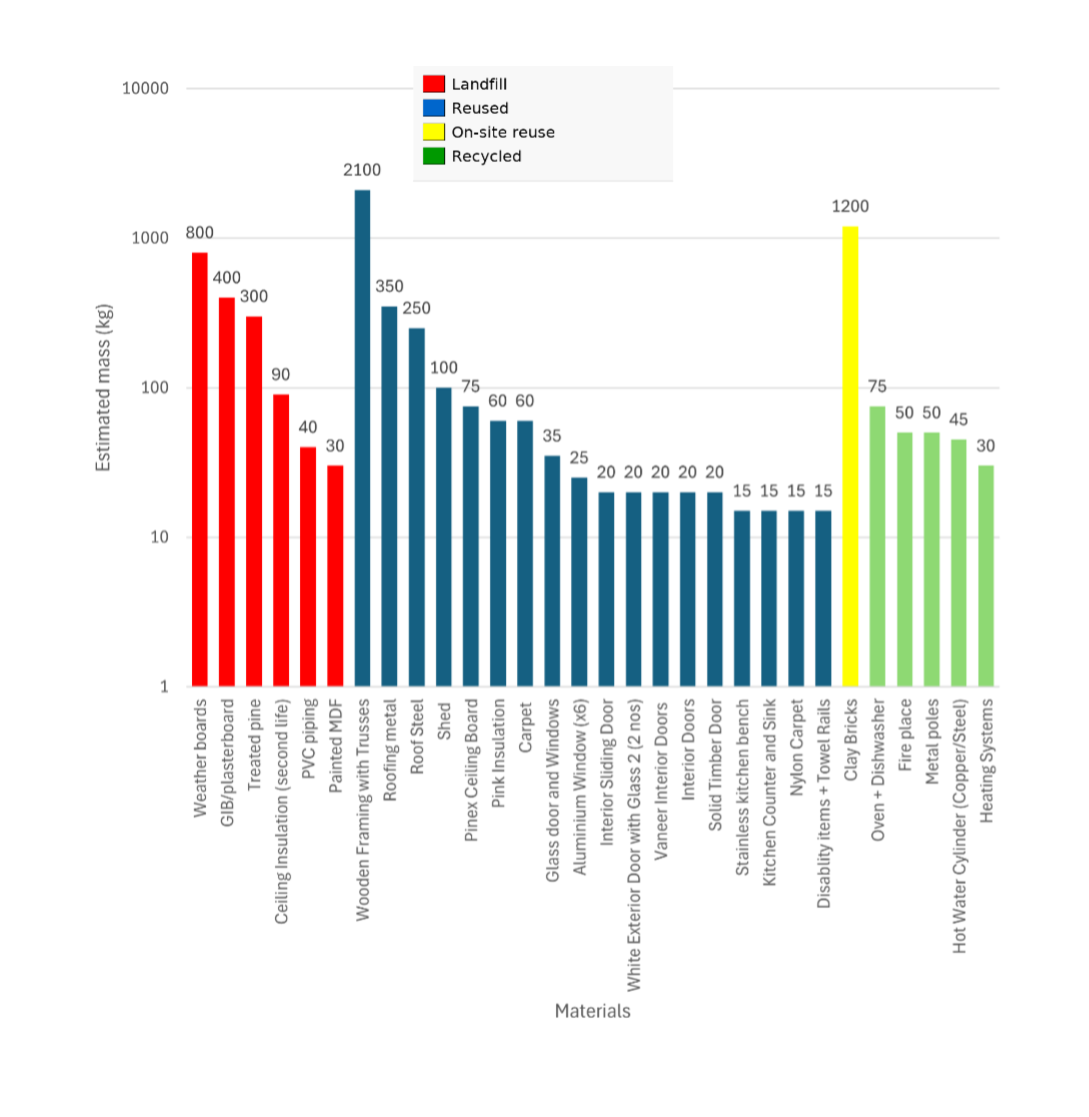
Figure 1: Material flows (salvaged vs landfill) from the Auckland house deconstruction.
Why does this matter for New Zealand builders?
Builders are being asked to cut waste and lower embodied carbon. As buildings get more energy-efficient in use, the bigger carbon opportunity shifts to the materials we build with. With councils such as Auckland Council pursuing ambitious zero-waste and low-carbon goals, end-of-life building decisions will matter more over time.
Deconstruction is one practical response. While this project didn’t sell reclaimed materials (it was research-focused), recovered items can help offset extra labour costs on commercial jobs.
Practical on-site takeaways
For new builds:
· Design simple layers so linings, services and structure can be separated.
· Prefer reversible mechanical fixings over permanent adhesives where possible.
For existing buildings:
· Ask “can we retrofit before we replace?” – retaining the structure saves the most carbon.
· If a building must come down, plan deconstruction into the build schedule, with an early material walk-through and an inside-to-outside salvage sequence.
For homeowners and communities:
· Remind people that existing buildings already store locked-in carbon and craftsmanship.
· If it’s safe and allowed, reuse materials on site or give them to someone locally instead of throwing them in the skip.
What would help this scale up?
This case study highlights system-level changes that could make deconstruction a routine part of a construction practice over time – much like multi-storey builds and seismic detailing are now.
Councils could pilot acceptance of quality-assured reclaimed products, supported by a simple materials passport (that records the source, basic properties, intended uses). A recognised template would help designers integrate eligible reclaimed products into Building Code workflows.
Standard details and training for deconstruction-friendly fixings and sequencing would help, alongside community awareness of resource value and craftsmanship.
A mindset shift: existing buildings as green buildings
This project experience reshaped what “useful” means for me as a builder-in-training. Deconstruction reduces skip-bin waste and supports repair and retrofit instead of constant replacement.
It proved that circular economy is not abstract – it is hard, physical work, but achievable even for a small crew. You do not have to be perfect to make a difference: notice what goes into your skip bins, and ask what could be reused, repaired or carefully deconstructed.
Existing buildings are already “green buildings”: they store locked-in carbon and craftsmanship.
One project at a time, we can treat them as a resource.