

What Is Asbestos and Where Is It?
What is Asbestos?
Asbestos is a naturally occurring mineral with heat-resistant properties, once widely used in construction for its durability and fireproofing qualities. There are six types of asbestos, each with unique properties; however, all types are hazardous when disturbed. When disturbed or damaged, tiny fibres can be released into the air and inhaled. Once in the lungs, the asbestos fibres can lead to the development of asbestos-related diseases such as asbestosis, lung cancer, and mesothelioma. There is often a long latency period - symptoms can appear several decades after the initial exposure event.
As a general rule, exposure risk is highest when asbestos materials are broken, damaged, or disturbed. It is therefore very important to know if you have any asbestos-containing materials in your house, where they are and what condition they are in.
Where is Asbestos Found in Buildings?
Asbestos was widely used in New Zealand during the 20th century, predominantly in building materials, for example, roofing, pipes, and insulation. It has been used in over 3,000 different products. Its use peaked in the 1970s, but declined as awareness of health risks grew, eventually leading to a ban on imports and finally a ban in 2016.
Despite being banned, people can still be exposed to asbestos in existing buildings when they deteriorate, are renovated, refurbished, deconstructed or demolished. Many buildings are likely to contain asbestos, especially if built before the year 2000.
Some ACMs have a higher risk than others, depending on their friability. Exposure risk is highest when asbestos materials are broken, damaged, or disturbed.

Asbestos-containing materials (ACMs) may still be present in:
Roofing, soffits and external cladding – asbestos cement for roof sheeting, cladding and soffits
Ceilings and walls – textured ceilings and coatings, asbestos cement sheeting, cladding
Flooring – vinyl tiles, carpet underlay. It is common in the paper underlay for flooring in bathrooms and kitchens.
Insulation – in roof cavities, fireplaces and around hot water pipes
Fire protection – Backboards to boilers and fuse boxes
Electrical components – switchboards, fuse boxes and electrical cabling
Wet areas – asbestos cement products were commonly used in kitchens, bathrooms, toilets and laundry areas
Exterior materials – in gutters, downpipes, gables and eaves, fences
Note: This list is not exhaustive.
It is very important to note that asbestos-containing materials may also be hidden underneath or behind other surfaces, for example, in wall cavities, ceilings, roofing, flooring (especially vinyl flooring), and electrical switchboards.
However, it is very difficult to tell if a building material contains asbestos just by looking at it – the only way is to take a sample and test it.
Therefore, it is highly recommended to contact a reputable asbestos specialist to identify asbestos in the home and if anything should be done with it.
Types of Asbestos
Some ACMs are more dangerous than others - this depends on several factors.
Friability - ACMs are categorised as either Class A or Class B, which affects the risk associated with asbestos.
Friable asbestos (‘Class A’) means that it is loosely bound, flaky, powdery, crumbles easily and breaks apart when touched or disturbed. It can easily release asbestos fibres. Some examples are sprayed insulation, pipe lagging and loose-fill insulation. Class A ACMs must only be removed by a Class A Licensed Asbestos Removalist (LAR).
Non-friable asbestos (‘Class B’) is bonded or encased in cement or other binding material; therefore less likely to release fibres unless it is cut or damaged. Over time, weathered or damaged non-friable asbestos can deteriorate or release fibres, so it is always best to consult a reputable Asbestos consultant and a LAR before asbestos removal works.
Class B ACMs must be removed by a Class B LAR, unless the extent is less than 10 m², in which case someone who is “trained in the identification and safe handling of, and suitable control measures for, asbestos and ACM” may carry out the works (Health and Safety at Work (Asbestos) Regulations 2016, section 17).
Damaged, deteriorated or weathered ACMs are more dangerous, as they are more likely to release fibres. Crumbling, flaking, water damage, peeling and abrasions all increase the risk. Intact and sealed materials generally pose a much smaller risk if they are left undisturbed.
We HIGHLY recommended having a LAR involved in any asbestos removal, even for small amounts of ACM.
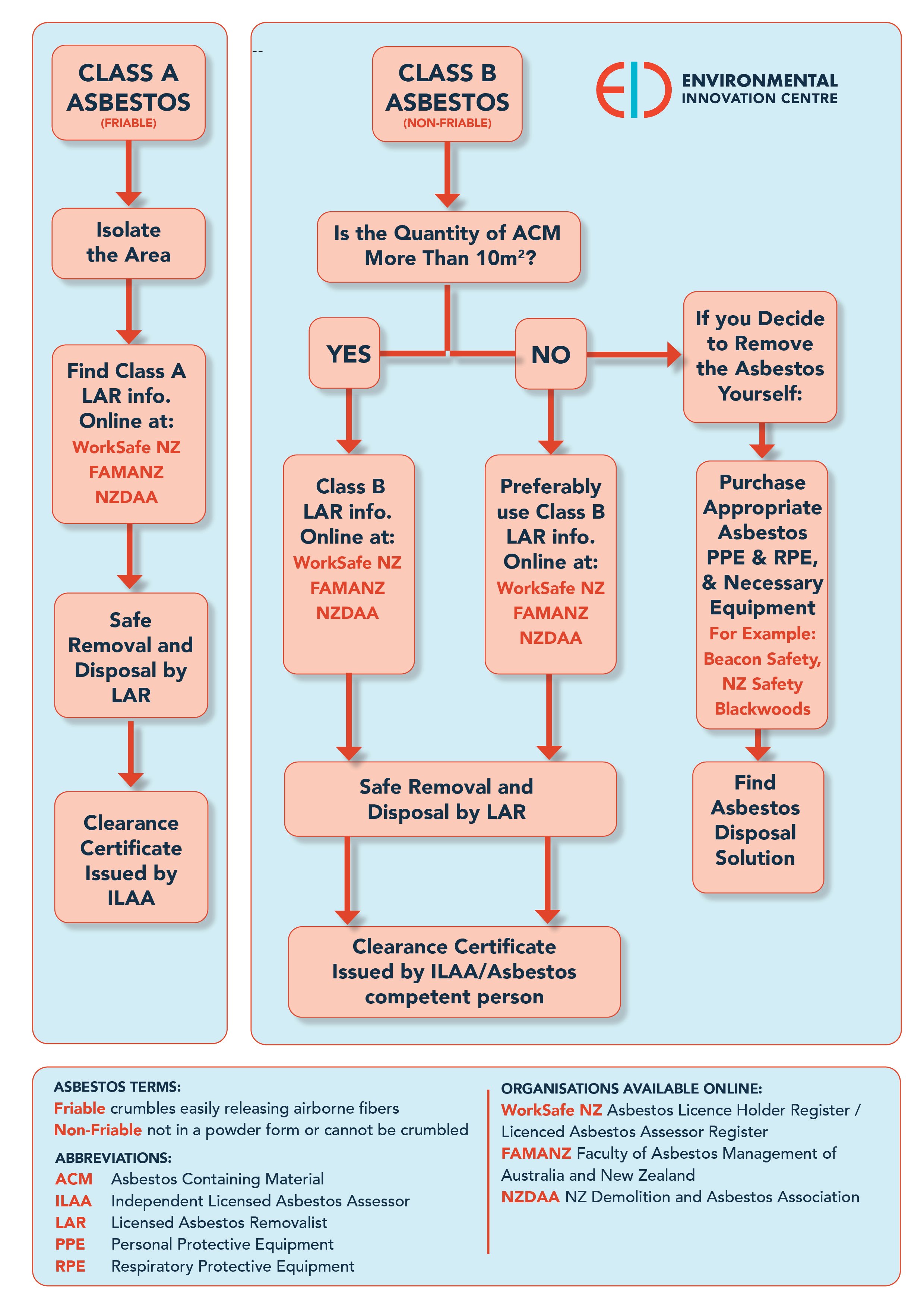
Who to contact:
If you are seeking asbestos advice or an Asbestos Surveyor, please visit:
Licensed Asbestos Removal contractor register:
Independent Licensed Asbestos Assessor register:
Asbestos removal / Demolition Info: New Zealand Demolition and Asbestos Association (NZDAA)
If you think you have been affected or know someone with an asbestos-related disease, contact the Mesothelioma Support and Asbestos Awareness (MSAA) Trust for support: