Advice for DIY-ers: How to Protect Yourself
We strongly recommend using a FAMANZ asbestos specialist to identify asbestos, and a Licenced Asbestos Removalist to remove and dispose of asbestos and asbestos materials safely. Attempting to remove or work on asbestos without specialist training can create a major hazard for you, others in your home, and your community.
We also recognise that this is not possible for everyone - therefore, we have produced advice for DIY-ers and homeowners on how to safely manage asbestos. This is based on WorkSafe NZ documents and knowledge from an asbestos specialist.
Please note – As a PCBU, if you are not a licensed asbestos removalist, you should ONLY be removing Class B (non-friable) asbestos, up to a maximum size of 10 m2 if you are ‘competent’ to do so with the correct Asbestos Respiratory Protective Equipment (RPE) & Personal Protective Equipment (PPE). ‘Competent’ means a person who has the knowledge, experience, skills, and qualifications to carry out a particular task under these regulations, including any knowledge, experience, skills, and qualifications prescribed in a safe work instrument.
If, despite the risks, you decide to carry out unlicensed removal of asbestos (allowed for Class B ONLY, if smaller than 10 m²), the following precautions should be taken:
-
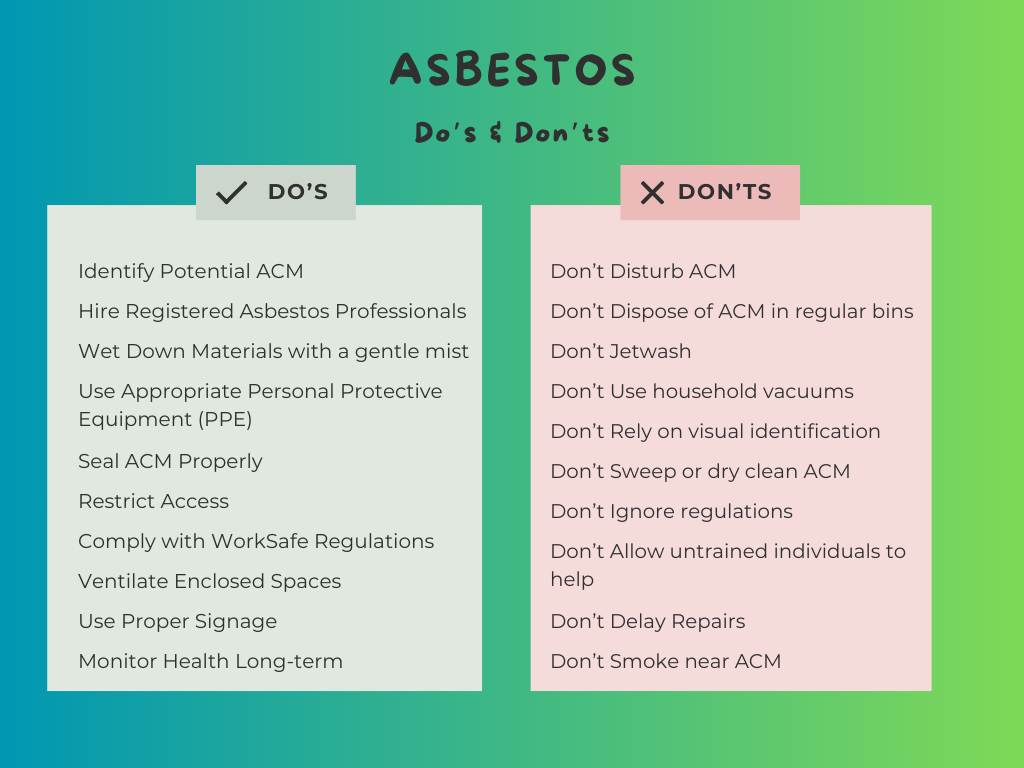
Use appropriate Personal Protective Equipment (PPE) that is easy to decontaminate and has minimal features (e.g. pockets) where asbestos fibres can get trapped.
PPE should include:
(1) Safety footwear
e.g. steel-capped, rubber-soled work shoes or gumboots. They should not have laces, which can trap fibres. Disposable boot covers should also be worn over the boots.
Store footwear upside down when not in use to minimise asbestos contamination. This footwear should stay inside the work/decontamination area for the duration of the asbestos work.
(2) Coveralls
Should be of a suitable standard that prevents tearing and asbestos fibre penetration (rated type 5, category 3 (EN ISO 13982–1) or equivalent). Make sure they have a fitted, elasticised hood and cuffs.
They should be one size larger than your usual size to prevent the seams from ripping.
The legs should be worn over footwear (do not tuck into boots), and any loose sleeve cuffs should be sealed with tape.
Wear your fitted hood over your respirator straps. Zip your coveralls all the way to the top.
Disposable coveralls should not be reused, taken home, made of easily torn material, or have external pockets with Velcro fastenings (too difficult to decontaminate).
Reusable coveralls should be taken to a laundry equipped to launder asbestos-contaminated clothing.
Under coveralls, wear old clothing that can easily be disposed of. Do not wear wool or other materials that attract fibrous dust. Any clothing worn under coveralls should be disposed of or laundered as asbestos-contaminated clothing.
(3) Respiratory protective equipment (RPE):
The minimum requirement is a mask with a P2 filter. However, P3 filter masks provide greater protection and are more effective than P2 masks, so we strongly recommend using P3 masks instead
Your mask should adhere to the AS/NZ1716 standard. The mask should be quantitative face fit tested to ensure a proper fit, and it is essential that you are clean-shaven before your mask is fitted. Conduct a fit check according to the RPE’s instructions and check for leaks. Clean & store RPE appropriately so that it prevents damage to the mask.
(4) Gloves
To prevent fibres from collecting under fingernails or in cuts and grazes. These may be low-protein, powder-free gloves (which prevent the development of latex allergies) or nitrile gloves. Do not wear gloves that are too tight or too big.
(5) Eye protection
Safety goggles should be used to protect the eyes from dust and other particles.
-
WHERE WILL IT GO?
Find a local disposal destination for the asbestos waste, and contact them to apply for a permit and confirm the procedure for disposal. Asbestos waste must be disposed of at facilities authorised to accept asbestos waste (see WorkSafe NZ website to find a list of approved landfills).
LIMIT EXPOSURE
Keep unnecessary people out of the work area. The asbestos removal area must be segregated.
Use appropriate signage to keep people and pets out. Let family, friends and neighbours know what you are doing before you start. Ask them to stay away from the area until you have completed the work.
PROTECT YOURSELF
PPE (described above) should include coveralls, lace-free boots and boot covers, a mask (half facepiece particulate respirator with P2 or P3 cartridge), single-use gloves and safety goggles (WorkSafe NZ, 2024b).
PREPARE YOUR SPACE
Prepare your PPE, equipment, disposal bags and decontamination measures before you start, including:
Correct tools for removal
Labelled, 200-micron-thick polythene asbestos waste bags and/or sheets for containing asbestos waste, as well as cable ties and duct tape.
Either a garden hose with a mist setting or a low-pressure spray bottle.
Disposable rags and wet wipes for decontamination and cleaning up. A bucket of water can be used to wet rags.
As much as possible, allocate:
A clean change area - where you put on clean work clothes and PPE before work starts.
A dirty decontamination area - where anything that has been exposed to asbestos is stored (e.g. footwear). This is where you go after asbestos work.
-
CONTAIN THE AREA
Lay down 200-micron-thick polythene (heavy-duty) sheets to catch dust and debris within your designated work area.
Sheets should be sprayed with water, cleaned and wiped with damp rags, then wrapped up and disposed of as asbestos waste at the end of the project.
KEEP IT DAMP: USE A LOW-PRESSURE SPRAY
Keeping the area damp prevents any loose fibres from becoming airborne. DO NOT spray water near electrical hazards.
Lightly mist asbestos materials with water and detergent or a polyvinyl acetate (PVA) solution (1-part PVA glue to 5-parts water) during removal works. Take care not to break the ACM during removal.
A spray bottle or garden hose with a mist setting works well. Keep materials damp while working – if you can see asbestos, wet it gently.
DO NOT jet-wash ACMs or vigorously scrub/brush surfaces on which fibres have settled.
-
CONTAIN & DISPOSE OF ACMs
All asbestos waste and small pieces of non-friable asbestos must be contained in new, heavy-duty (200-micron minimum) polythene asbestos waste bags (maximum size of 1.2m x 0.9m to reduce manual handling injuries).
Larger ACMs (e.g. sheeting, pipes or long/large items) should be double wrapped in heavy-duty 200-micron polythene sheets and taped over every overlap to minimise tearing or splitting.
All waste (including coveralls, boot covers, wet wipes, and rags) must be disposed of as contaminated asbestos waste. All asbestos waste must be double-bagged in 200-micron asbestos waste bags, and sealed.
Clean the external surfaces of each bag before removing it from the area.
Asbestos waste bags should not be more than half-filled to prevent them from tearing and splitting.
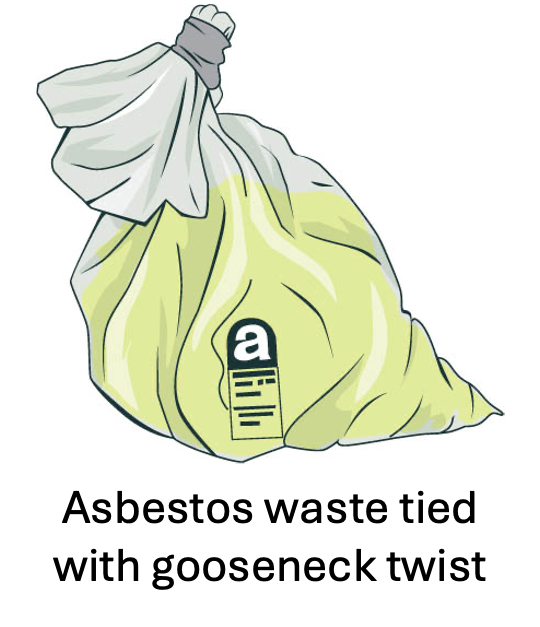
The asbestos waste bags should be goose-necked (twist the top of the bags tightly and fold the necks over) and secured with cable ties and duct tape.
External surfaces should be wiped down, then the bag put into another asbestos waste bag and secured.
Label the package with asbestos warning labels.
Once asbestos waste has been removed, double-bagged or wrapped, it should be placed in an appropriate secure container for eventual disposal or immediately removed and transported to the asbestos waste disposal site.
A general waste skip should NEVER be used for asbestos waste disposal.
See the Recycling Services Finder or the Asbestos Waste Disposal table for local disposal options.
-
You must decontaminate yourself each time you leave the work area. Removing your RPE should be the last stage of decontamination after asbestos work.
It is suggested to decontaminate using these steps:
1. Tools – wipe these down with wet wipes or wet rags. Put into asbestos waste bag.
2. Polythene sheets (on the ground/surfaces) – wipe down with rags and fold up. Put into asbestos waste bag.
3. Move into the decontamination area – with all your PPE on, spray yourself all over with the water spray. Clean coveralls and the exterior of your mask with wet wipes or damp rags. KEEP YOUR MASK ON
4. Remove coveralls – in this order: remove hood, unzip, roll the coveralls down the body and turn them inside out as you remove them. Step out of the coveralls. Put into asbestos waste bag.
5. Boots – remove boot covers in the same way as your coveralls and put into the asbestos waste bag. Use wet wipes or rags to wipe down your hands and boots. Put into asbestos waste bag.
6. Mask – put on clean gloves, then use wet wipes to clean the inside of your mask.
7. YOU CAN NOW REMOVE YOUR MASK. Once it has been decontaminated, you can store it securely. If it is single-use, put it into an asbestos waste bag.
8. Thorough washing - Carefully wash yourself with soapy water, and pay particular attention to your hands, fingernails, face and head. Shower and wash your hair.